|
for Seismic Wave Propagation on Regional and Global Scales Gunnar Jahnke Department of Earth and Environmental Sciences,
|
 |
|
for Seismic Wave Propagation on Regional and Global Scales Gunnar Jahnke Department of Earth and Environmental Sciences,
|
|
Last update: 22. June 2013
|
Numerical Methods for Seismic Wave Propagation on Regional and Global Scales Link to thesis Regional modelling: 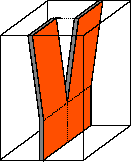
Simulation of regional 3D models is done for fault zones, especially to investigate so calledTrapped Waves which are very sensible on fault structure at depth (for example seismograms see here). The detailed structure of a fault zone (FZ) plays an important role in problems related to fault mechanics, dynamic rupture, wave propagation and seismic hazard. FZs are thought to consist of a O(10-100)m wide region of decreased seismic velocity. The small spatial scales involved make such structures difficult to image with ray-theoretical methods (tomography). However, when seismic sources are located at or near such low-velocity structure, energy is trapped inside the FZ leading to dispersive wave trains carrying information on the FZ structure. These waves can travel many kilometers inside the fault before reaching the surface and are therefore strongly altered by its properties. Candidate trapped waves have been observed above several active faults. Inversion algorithms exist which explain these observations in terms of planar fault zone structures. However, at present it is not clear how reliable these estimates are as the effects of (even small) 3-D variations on trapped waves are not well understood. The goal of this study is to distinguish relevant and irrelevant effects on FZ waves due to 3-D structure. To achieve this we perform numerical calculations of various FZ geometries and analyze the waveforms, spectra and envelopes of synthetic seismograms. The main results are that (1) moderate changes of the shape of FZ or (2) small scale heterogeneities or (3) depth-dependent properties do not strongly affect the observed FZ waves. In contrast, strong effects are to be expected from (4) discontinuous FZ structure (e.g. offsets), which may at some point allow imaging such features at depth. The used method is a 3D high-order staggered-grid finite-difference scheme. The Fault Zone modelling is done in collaboration with Prof. Heiner Igel (Geophysics Section, of the Department of Earth and Environmental Sciences, Ludwig - Maximilians Universität München) and Yehuda Ben-Zion (Department of Earth Science, University of Southern California, Los Angeles). |
Global modelling:
The Simulations are done on high performance computers such as the Hitachi SR8000 Computer at the Leibniz Rechenzentrum München. The implementation is done with Fortran90 and MPI. |
|
with Tarje Nissen-Meyer and Markus Treml 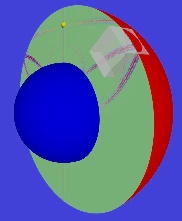 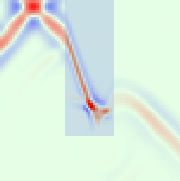 In
order to simulate teleseismic wavefields entering regional structures,
a combination of regional 3d modeling in a spherical section and global
axi-symmetric modeling was implemented (see Figure on the right and this
poster
presentation). An application for that is e.g. modeling teleseismic
registrations on top of a regional plume structure. This method is capable
of simulating high frequencies, since for large parts of the model space
the efficient axi-symmetric wave propagation is used. Full 3D simulation
is only done in a regional part, defined by a spherical section. At each
time step of the computation, velocities and stresses have to be passed
from the axi symmetric to the spherical section. Restrictions of this method
are (1) source and background model have to be axi-symmetric and (2) the
3D section has to be at the surface, since transition of an abitrary 3D
wave field back to the axi symmetric section is not possible. The figure
on the left shows a cross section along the great circle path for a plume
like low velocity structure (vertical cylinder). The axi symmetric wave
field (SH-component) has already entered the 3D section. The wave field
is diffracted and the wave lengths are shortened within the cylinder due
to the lower velocity inside. In
order to simulate teleseismic wavefields entering regional structures,
a combination of regional 3d modeling in a spherical section and global
axi-symmetric modeling was implemented (see Figure on the right and this
poster
presentation). An application for that is e.g. modeling teleseismic
registrations on top of a regional plume structure. This method is capable
of simulating high frequencies, since for large parts of the model space
the efficient axi-symmetric wave propagation is used. Full 3D simulation
is only done in a regional part, defined by a spherical section. At each
time step of the computation, velocities and stresses have to be passed
from the axi symmetric to the spherical section. Restrictions of this method
are (1) source and background model have to be axi-symmetric and (2) the
3D section has to be at the surface, since transition of an abitrary 3D
wave field back to the axi symmetric section is not possible. The figure
on the left shows a cross section along the great circle path for a plume
like low velocity structure (vertical cylinder). The axi symmetric wave
field (SH-component) has already entered the 3D section. The wave field
is diffracted and the wave lengths are shortened within the cylinder due
to the lower velocity inside. |
|
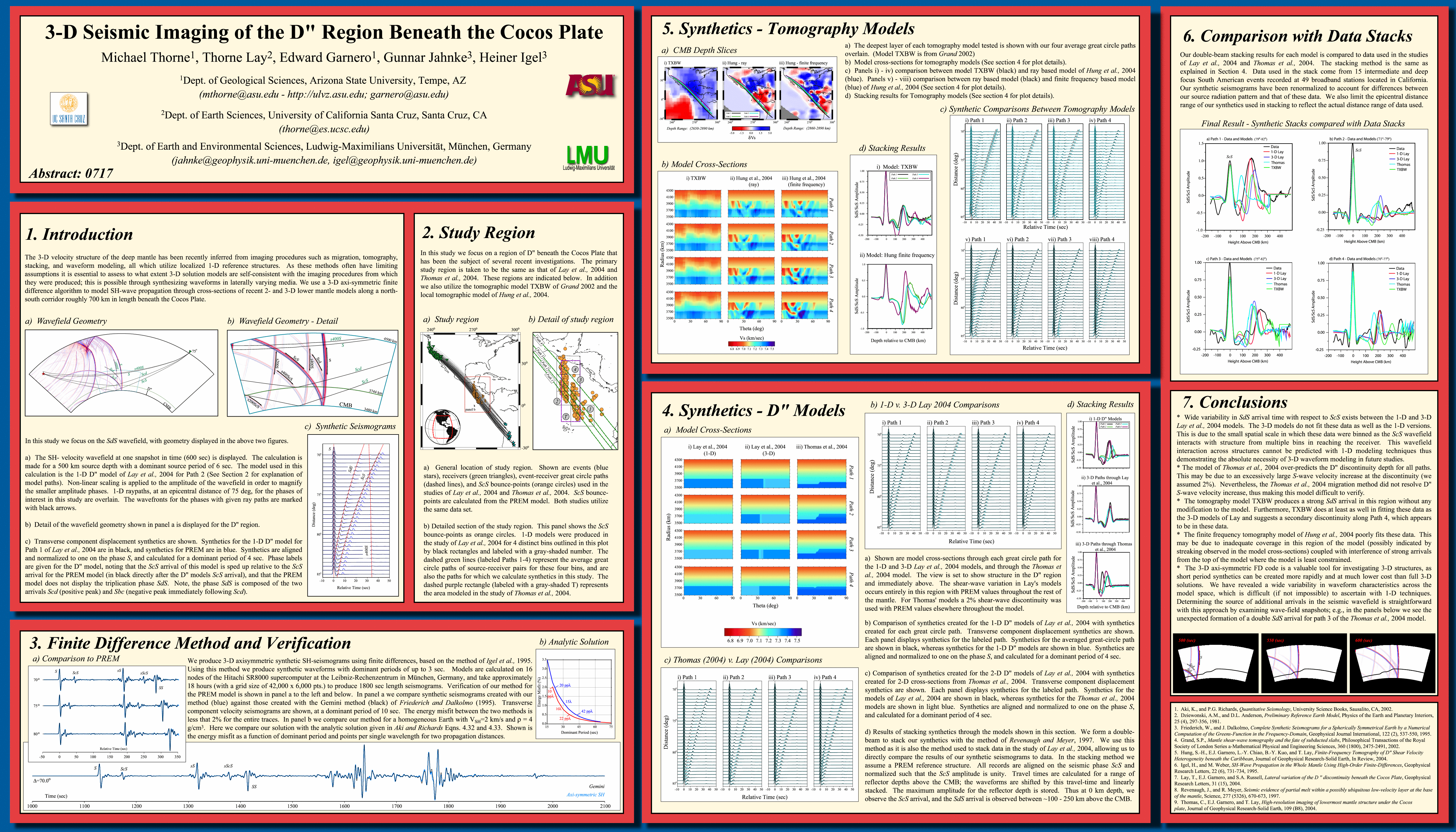
[11] Thorne, M. S., H. P. Crotwell, G. Jahnke, An educational resource for visualizing the global seismic wavefield, (PDF), SRL, 84 (4), 711-717, 2013. [10] Thorne, M. S., Garnero, E.J., Jahnke, G., Igel, H., McNamara, A.K., Mega Ultra Low Velocity Zone and Mantle Flow (PDF), EPSL, 364, 59-67, 2013. [9] Jahnke, G., Methods for Seismic Wave Propagation on Local and Global Scales with Finite Differences. (PDF), PhD Thesis, LMU München: Faculty of Geosciences, 2010. [8] Jahnke, G., M. S. Thorne, A. Cochard, H. Igel, Global SH-wave propagation using a parallel axi-symmetric finite-difference scheme: application to whole mantle scattering (PDF), Geophys. J. Int., 173(3): 815-826, 2008. [7] Thorne, M. S., T. Lay, E. Garnero, G. Jahnke, H. Igel, 3-D Seismic Imaging of the D" region beneath the Cocos Plate , Geophys. J. Int., 170, 635-648, 2007. [6] Jahnke, G., H. Igel and Y. Ben-Zion, Three-dimensional calculations of fault zone guided waves in various irregular structures (Paper, Movies), Geophys. J. Int., 151, 416-426, 2002. [5] Igel, H., G. Jahnke, and Y. Ben-Zion, Numerical simulation of fault zone trapped waves: accuracy and 3-D effects (PDF), Pure Appl. Geophys., 159, 2067-2083, 2002. [4] Fohrmann, M., H. Igel, G. Jahnke, Y. Ben-Zion, Guided waves from sources outside faults: an indication for shallow fault zone structure? (PDF), Pure Appl. Geophys., 161, 1-13, 2004. [3b] Igel, H., G. Brietzke, H. Igel, G. Jahnke, M. Treml, M. Ewald, H. Wang, A Cochard, G. Wang, Computational Elastic Wave Propagation: Advances in Global and Regional Seismology (PDF), High Performance Computing in Science and Engineering, Munich 2004, Springer Verlag, pp. 447, ISBN 3-540-44326-6. [3] Igel, H., Nissen-Meyer, T., Jahnke, G., Wave propagation in 3D spherical sections: effects of subduction zones (PDF, HTML), Phys. Earth Planet. Int., 132, 219-234, 2002. [2b] Brietzke, G., H. Igel, G. Jahnke, M. Treml, M. Ewald, H. Wang, A. Cochard and G. Wang, Computational wave propagation: advances in global and regional seismology (PDF), Report for the Leibniz Rechenzentrum (LRZ), München, 2003. [2] Igel, H., G. Brietzke, M. Ewald, M. Fohrmann, G. Jahnke, T. Nissen-Meyer, J. Ripperger, M. Strasser, M. Treml, and G. Wang, 3-D seismic wave propagation on a global and regional scale: earthquakes, fault zones, volcanoes (PDF), High Performance Computing in Science and Engineering, Munich 2002, Springer Verlag, pp. 353, ISBN 3-540-00474-2. [1] Weber, M., Ch. W. Wicks, F. Krüger, G. Jahnke, J. Schlittenhardt, 1998, Asymmetric radiation of seismic waves from an atoll - Nuclear tests in French Polynesia (Abstract), Geophys. Res. Lett., 25, 1967-1970. Presentations: [16] Jahnke, G., N. Gestermann, G. Hartmann, L. Ceranna, M. Henger, Seismic Identification of the 2006 North Korean Nuclear Explosion with the IMS Network - Data Analysis and Numerical Modelling, (Abstract, Meeting of the European Geosciences Union (EGU), Apr. 2007, in Vienna (Geoph. Res. Abs, Vol. 9, 08932, 2007). [15] Jahnke G., N. Gestermann, A. Schick, L. Ceranna, M. Henger, Operation of the Earthquake Alert and Information System ALISE, (German Abstract ), Meeting of the German Geophysical Society (DGG), Mar. 2006, Bremen. [14] Jahnke G., N. Gestermann, G. Hartmann, A. Schick, L. Ceranna, M. Henger, 'ALISE' - The Alert and Information System for Earthquakes in Germany, (Abstract ), Meeting of the European Geosciences Union (EGU), Apr. 2005, in Vienna (Geoph. Res. Abs, Vol. 7, 11025, 2005). [13] Canty, M., G. Jahnke, A. Nielsen, J. Schlittenhardt, Change Detection for Remote Monitoring of Underground Nuclear Testing: Comparison with Seismic and Associated Explosion Source Phenomenological Data, (Abstract, Poster), Meeting of the European Geosciences Union (EGU), Apr. 2005, in Vienna (Geoph. Res. Abs, Vol. 7, 07208, 2005). [12] Jahnke G., N. Gestermann, G. Hartmann, A. Schick, L. Ceranna, M. Henger, 'ALISE' - The Alert and Information System for Earthquakes in Germany - First Experiences, (German Abstract, Poster), Meeting of the German Geophysical Society (DGG), Mar. 2005, in Graz. [11] Gestermann, N., G. Jahnke, G. Hartmann, A. Schick, L. Ceranna, M. Henger, An Alert- and Information System for Earthquakes in Germany, (German Abstract, Photo), Meeting of the German Commitee for Disaster Reduction (DKKV), Oct. 2004, Mainz. [10] Gestermann, N., G. Jahnke, G. Hartmann, L. Ceranna, M. Henger, Development of an Earthquake Information System for Germany, (Abstract), Poster, Meeting of the European Seismological Commission (ESC), Sep. 2004, Potsdam. [9] Gestermann, N., G. Jahnke, L. Ceranna, G. Hartmann, M. Henger, Automatic Detection Routines for an Earthquake Alert System, (Abstract, Poster, in German), Meeting of the German Geophysical Society (DGG), Mar. 2004, Berlin. [8] Jahnke, G., H. Igel, High Resolution Global Wave Propagation through the whole Earth: the axi-symmetric PSV and SH case (Abstract), (Poster), EGS General Assembly, Apr. 2003, Nice, France (Geoph. Res. Abs., Vol. 5, 08346, 2003). [7b] Igel H., M. Fohrmann, G. Jahnke and Y. Ben-Zion,
Guided Waves From Sources Outside Faults: An Indication For Shallow Fault Zone Structure?
(PDF),
ACES Workshop Proceedings, 173-176, May 2002, Hawaii.
[6] Jahnke, G., H.
Igel,
High frequency global wave propagation with the FD method for
axi symmetric geometries (PDF,
in German), Meeting of the German Geophysical Society (DGG), Mar. 2002,
Hannover.
[4b] Igel, H., Jahnke, G., Käser, M., Ben-Zion, Y., Wave propagation simulation on regional scales: algorithms and applications (PDF), (Abstract), ACES Workshop Proceedings, Oct. 2000, Tokyo and Hakone, Japan. [4] Jahnke, G., Igel, H., Ben-Zion, Y., 3D seismic wave propagation in fault zones - can trapped waves be used for a better resolution of the structure of a fault? (PDF), General Assembly of the European Seismological Commission (ESC), Sep. 2000, Lisbon, Portugal. [3] Jahnke, G., Igel, H., Ben-Zion, Y., Three Dimensional Wave Propagation in Seismic Fault Zone Models (HTML), Meeting of the German Geophysical Society (DGG), Feb. 2000, München. [2] Jahnke, G., Igel, H., Ben-Zion, Y., Three-dimensional wave propagation in fault structures with material interfaces and depth-dependent properties (PDF), AGU Fall Meeting, Dec. 1999, San Francisco. [1] Jahnke, G., M.
Weber,
Reflexionen im tiefen Erdmantel unter Neu Kaledonien (Abstract,
Poster, in German),
Meeting of the German Geophysical Society (DGG), Mar. 1998, Göttingen.
Publications using the SHaxi code: [A8] Hwang, Y. K., J. Ritsema, P. E. van Keken, S. Goes, E. Styles,
Wavefront healing renders deep plumes seismically invisible
(PDF), Geophys. J. Int. (2011) 187, 273-277.
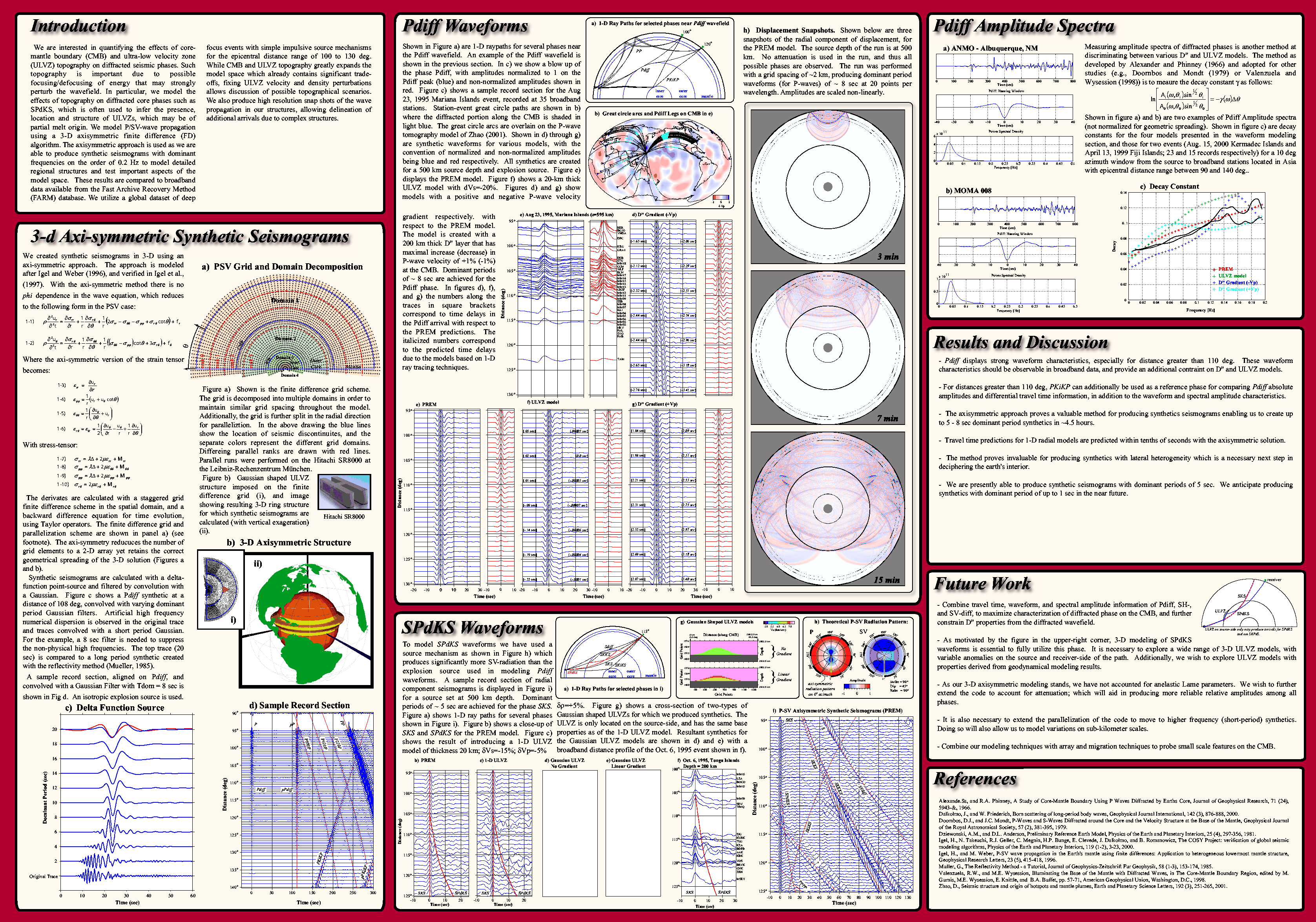
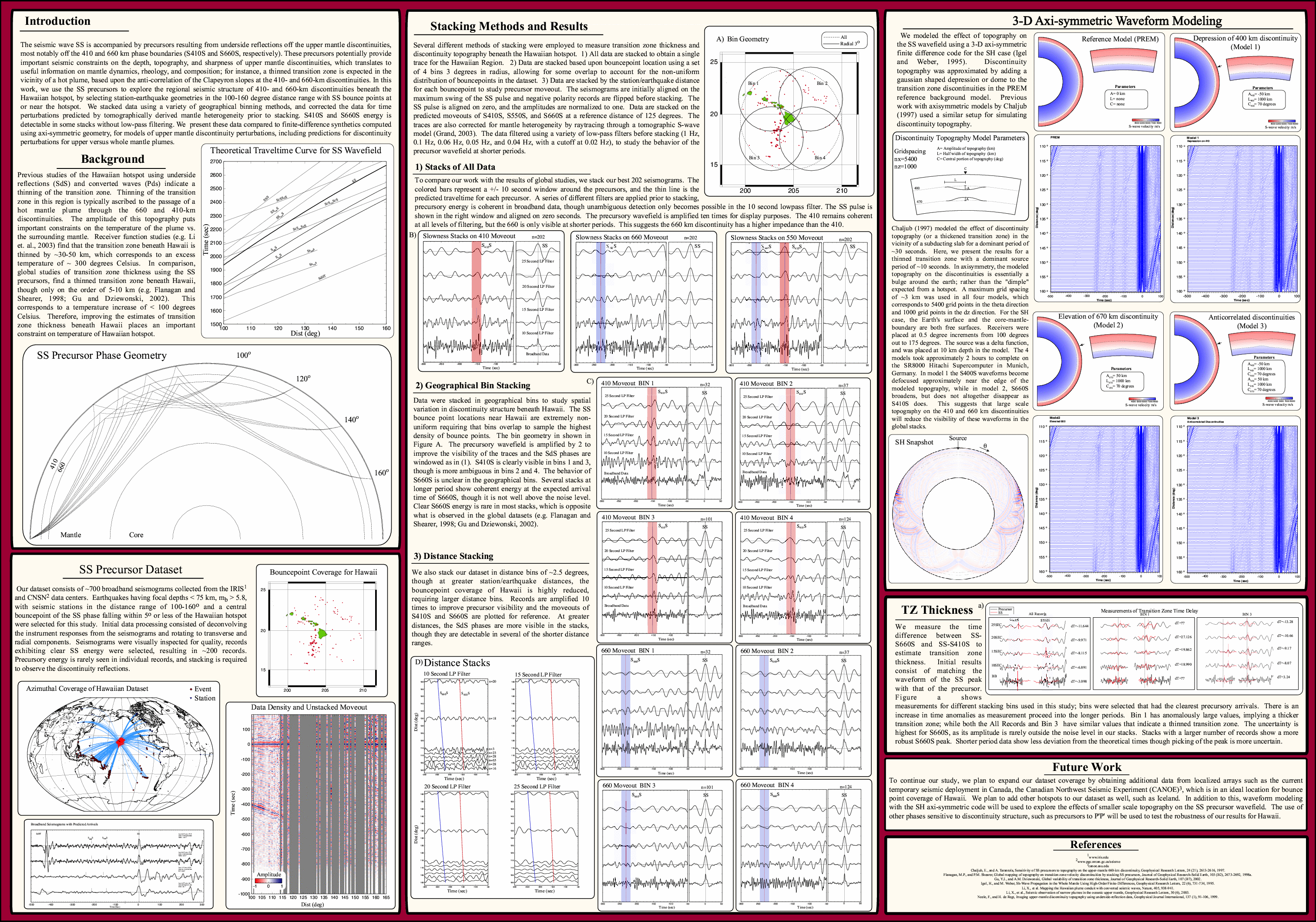
Work of the Seismology Group of the Arizona State University using the Axi-Symmetric Codes: [A7] Thorne, M. S., E. J. Garnero, A. K. McNamara, G. Jahnke, H. Igel, Broadband SPdKS waveforms reveal ULVZ ridge in the central Pacific (PDF), AGU Fall Meeting, Dec. 2008, San Francisco. [A6] Thorne, M. S., S. Rost, G, Jahnke, H. Igel, Analysis of Pdiff coda using the axi-symmetric finite difference method (PDF), AGU Fall Meeting, Dec. 2007, San Francisco. [A5] Thorne, M. S., Thorne, L., Garnero, E., Jahnke, G., Igel, H., 3-D seismic imaging of the D'' region beneath the Cocos Plate (Abstract), (Poster.png, 1.6MB), Eos Trans. AGU, 85(47), Fall Meet. Suppl., Abstract U41A-0717, 2004. [A4] Thorne, M. S., Garnero, E., Jahnke, G., Treml, M., Igel, H., Investigating the Core-Mantle Boundary and ULVZ Topography with Synthetic FD Seismograms for 3-D Axi-Symmetric Geometries: Predictions and Data (Abstract), (Poster.png, 580kB), Eos Trans. AGU, 84(46), Fall Meet. Suppl., Abstract U51B-0003, 2003. [A3] Treml, M., G. Jahnke, T. Nissen-Meyer, H. Igel, E. Garnero, A Hybrid Finite-Difference Method for Global Wave Propagation (Abstract), DGGAnnual Meeting, Jena, Germany, 2003. [A2] Treml, M., S. Goes, G. Jahnke, T. Nissen-Meyer, H. Igel, Synthetic Seismic Wave Propagation through thermal Mantle Plumes (Abstract), EGS-AGU-EGU General Assembly, Nice, France, 2003. [A1] Schmerr,
N., Garnero, E., Igel, H., Treml, M., Jahnke, G., Probing
the nature of 410- and 660-km discontinuities beneath hotspots using
the SS-precursors
(Abstract),
(Poster.png, 900kB),
Eos Trans. AGU, 84(46), Fall Meet. Suppl., Abstract S21E-0356, 2003.
Misc: Diplom Thesis: Analysis of weak seismic signals from small aperture arrays -
possibilities and limits Skript: Musterlösungen
zur Vorlesung Digitale Signalverarbeitung in der Seismologie I und II,
(PDF),
basierend auf der
gleichnamigen Vorlesung von Gerhard Müller, zusammengestellt von Gunnar Jahnke.
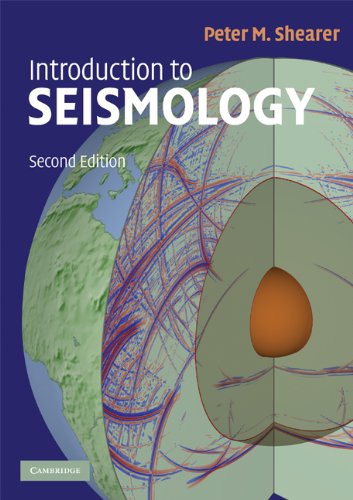
Fun Stuff: SHAxi snapshot at IRIS Image Gallery. Cover illustration: Introduction to Seismology (Textbook, P. Shearer, 2009). PSVaxiAnimation bei Focus Terra Mikes Animations of Earth and Moon quakes (SHaxi and PSVaxi)
3-D Seismic Wave Propagation on a Global and Regional Scale: Earthquakes, Fault
Zones, Volcanoes
(2001)
|
|
SPICE is a European network and stands for "Seismic wave Propagation and Imaging in Complex media". It maintains a Code-Library of wave propagation and other algorithms. You can get some of my Finite Difference codes from the SPICE code-libray. Already included are:
|
Tutorial: Understanding seismic radiation patterns

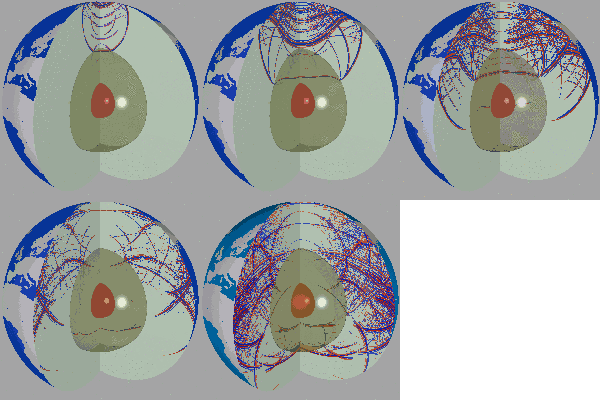 The
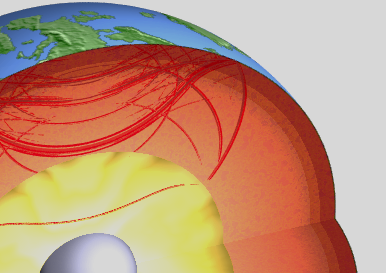
global seismic modelling is done for models and sources with axi symmetry.
That means the model space is parameterized in radial and one angular (theta)
direction and the grid has the shape of a 2D circle. To obtain the corresponding
3D image of the earth, one has to rotate the circle along the theta=0/pi
axis (in phi direction).
The
global seismic modelling is done for models and sources with axi symmetry.
That means the model space is parameterized in radial and one angular (theta)
direction and the grid has the shape of a 2D circle. To obtain the corresponding
3D image of the earth, one has to rotate the circle along the theta=0/pi
axis (in phi direction). 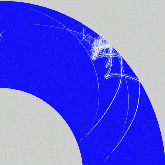 higher
frequencies. The axi symmetry in the algorithm restricts one to axi symmetric
models and sources. Thus things like point scatterers or double couple
sources can not be modeled. However, for many teleseismic questions it
is far more important to be able to simulate realistic frequencies (e.g.
~1Hz for body waves) than variations of the seismic parameters along all
three spartial directions. Some of these questions are: diffraction at
the CMB, teleseismic effects of subduction zones and scattering within
the mantle due to small scale inhomogeneities.
higher
frequencies. The axi symmetry in the algorithm restricts one to axi symmetric
models and sources. Thus things like point scatterers or double couple
sources can not be modeled. However, for many teleseismic questions it
is far more important to be able to simulate realistic frequencies (e.g.
~1Hz for body waves) than variations of the seismic parameters along all
three spartial directions. Some of these questions are: diffraction at
the CMB, teleseismic effects of subduction zones and scattering within
the mantle due to small scale inhomogeneities.